2026-01-20
The Comfort, Joy & Meaning Framework: Joy
Insights from our Senior Director of Brand Strategy, Samantha Scantlebury
SHARE ARTICLE
Download Report
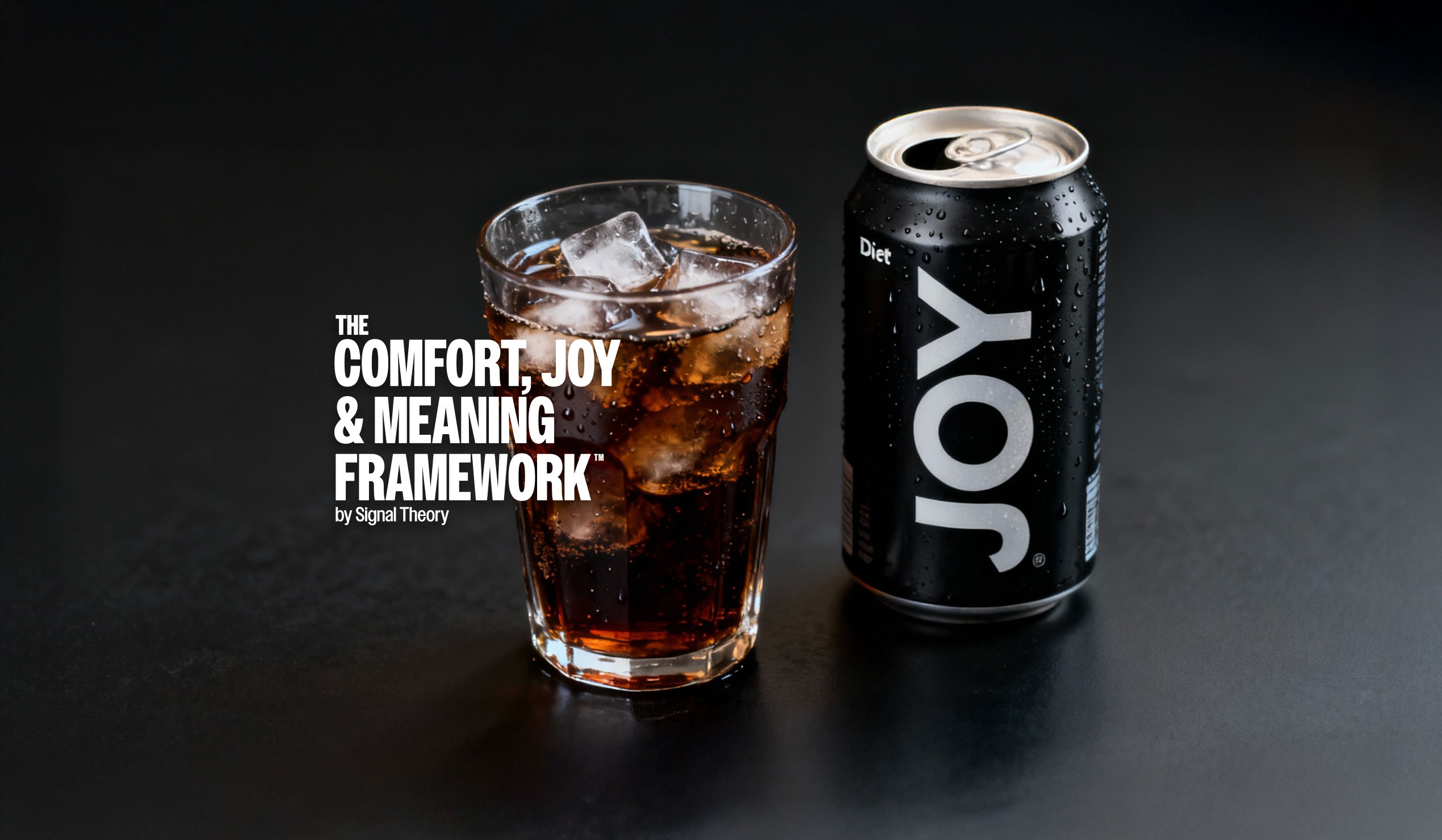
Anyone who knows me relatively well knows that I have a Diet Coke problem. Ok, it’s an addiction. Yes, it’s the cold jolt of aspartame in the morning that gets my day going. But it’s also joy in the ritual. And I will tell people as much. Cracking open a can on my morning commute while listening to a podcast truly makes me happy and puts me in the right frame of mind to take on the day.
As I think about it, Diet Coke has been a part of many joyful moments throughout my adult life:
I remember excitedly packing several in the cooler for cross-country road trips with my spouse.
When I worked with my dad for a couple of years, we’d regularly start meetings together with a mischievous smile and the phrase “You got the Diet Cokes?”
And after getting the kids down to bed, I regularly enjoy summer evenings out on my back porch listening to the sound of cicadas while sipping a Diet Coke. (If you’re concerned, I’m a bit of a night owl, so the caffeine in the evening doesn’t impact my sleep.)
Yes, these are personal moments of nostalgia, enjoyment and anticipation. But any marketer is aware that the Coca-Cola Company has intentionally designed its brand for over a century to lead into moments just like these.
How Coca-Cola Engineered Emotional Connection
In Atlanta, visit the World of Coca-Cola museum, and you’ll be reminded that from its inception to today, the brand has been about delivering happiness (you might recall the tagline, “Open Happiness”). From Santa’s jovial smile on old holiday tin sign ads to personalized names on bottles and cans inviting us to “Share a Coke,” Coca-Cola exists to delight its customers. (And talk about delight, you’re missing out if you haven’t visited the Taste It! room in the World of Coca-Cola where you can taste products from across the globe.)
What Coca-Cola figured out early - perhaps earlier than any other brand - is the power of emotional connection ignited by delivering joy.
Think about when you’ve been delighted by or felt sweet nostalgia for or excitedly anticipated experiencing a brand. It’s more than just a transaction, it’s a stronger feeling that makes you compelled to engage, purchase and tell others about it.
This year, Signal Theory explored the power of connecting through Joy as a part of a new proprietary study and methodology called the Comfort, Joy & Meaning Framework. In this research, we sought to understand if delivering on core human wants of Comfort, Joy and Meaning (which are connected to Maslow’s Hierarchy of Needs) made brands more successful in business results. The short answer? Absolutely.
Proving the Impact of Joy
The impact of delivering on Joy is more than speculative. We now have hard data that shows that brands that are stronger in delivering on the dimensions of Joy perform better in awareness and word-of-mouth – people simply can’t keep quiet about them.
We recently launched a full report on the Comfort, Joy & Meaning Framework. In a world where consumers are inundated with marketing messages, we can prove that resonating with them through the generated emotions of Comfort, Joy and/or Meaning is where the impact can be made. To draw our conclusions, we surveyed 1,500 people in the United States and had 25 brands scored on how well they delivered on different dimensions of Comfort, Joy and Meaning. These well-known brands represented six major industries from food to apparel to technology. We also asked respondents questions about their behaviors and attitudes about the brands, including purchase and repurchase behaviors, likelihood to share their brand experience and loyalty toward the brand.
We’d love for you to register and download the report and dive into all the learnings.
What the Comfort, Joy and Meaning Framework Reveals
When we dug into the data, clear patterns emerged about which brands win – and why. Among the things you'll learn are:
Brands with the highest Signal Strength (our measure of resonance) are top scorers on Comfort, Joy and Meaning.
It is in fact more common for brands overall to score well on Comfort, than it is to score well on Joy than it is to score well on Meaning (just as Maslow’s Hierarchy suggests).
Strong results in Comfort, Joy and Meaning have strong positive correlations with key marketing measures including repurchase, word-of-mouth and brand advocacy.
The report will also share and break down the scores of the highest-performing brands surveyed, providing a deeper layer of understanding of the score and how it translates to brand and marketing efforts.
Reading this report alone gives marketers concrete proof points for why investing in the emotions of Comfort, Joy and Meaning make good business sense. It’s also possible for your brand to get its own Signal Strength score. Having this score enables your brand to:
Better align with your audiences’ Comfort, Joy and Meaning wants
Use scores on different dimensions of Comfort, Joy and Meaning to guide product, marketing and messaging strategies
Drive measurable growth by improving your brand resonance.
If interested in getting a score for your brand, contact our Senior Director of Growth, Seth Gunderson.
Conclusion: The Power of Joy (and Comfort and Meaning)
Our hope at Signal Theory is that you find the Comfort, Joy & Meaning Framework more than a metric, but a call to action. People are wanting (even craving) deeper connection, and many brands are missing the opportunity. Those that truly understand how to ignite Joy stand to win over consumers at a deeper level, and even inspire them to tell others about you.
I’ll be over here joyfully sipping my Diet Coke hoping that we hear from you.